


The Platypus

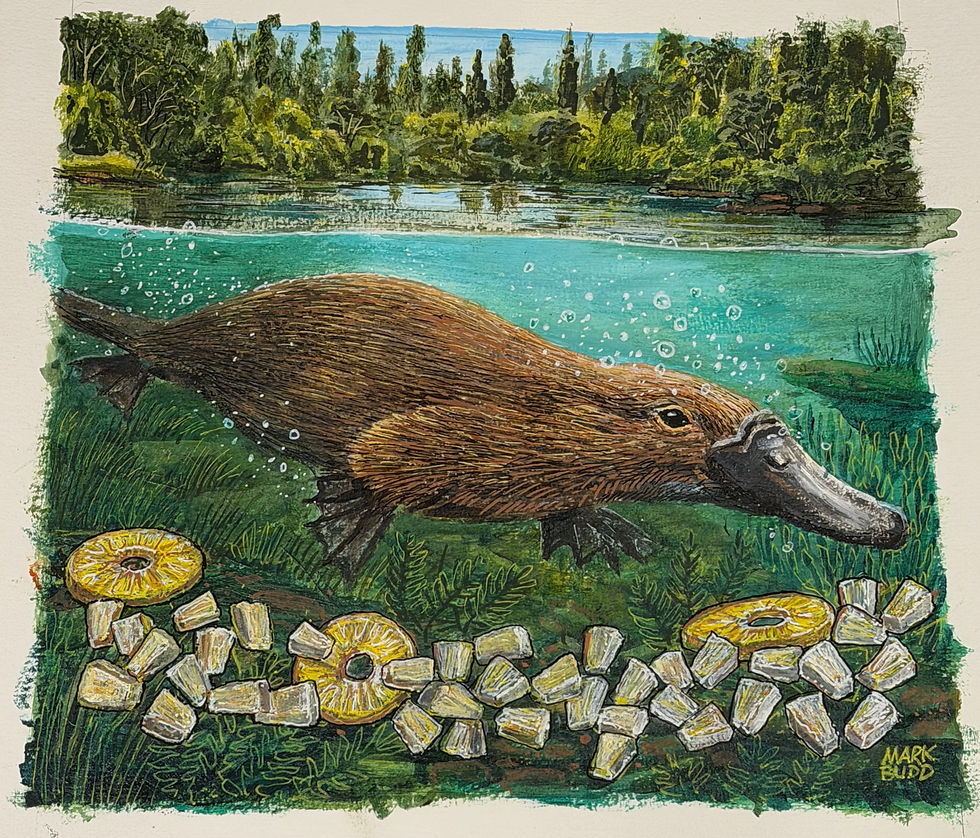
Platypuses (Ornithorhynchus anatinus) are semi-aquatic, egg-laying mammals found only in Australia. They belong to an ancient group of mammals called monotremes, which lay eggs rather than birthing live young.

The platypus is the only living species in the family Ornithorhynchidae, making it one of the most evolutionarily distinctive mammals on Earth (Australian Museum, n.d.; UNSW Platypus Conservation Initiative, n.d.).
Platypuses live in freshwater rivers, creeks, streams, lakes and other bodies of water across eastern Australia and Tasmania. They rely on healthy waterways with stable banks for burrowing, native vegetation for cover and aquatic invertebrates for food. Their sensitive bill contains electroreceptors and pressure receptors, allowing them to detect prey underwater while their eyes, ears and nostrils are closed (Australian Museum, n.d.).
Their natural range extends from northern Queensland through New South Wales, the Australian Capital Territory, Victoria and Tasmania. Platypuses were once recorded in mainland South Australia, including the Adelaide Hills and Mount Lofty Ranges, but they are now considered extinct in the wild on the SA mainland. Today, South Australia’s main wild population is the introduced population on Kangaroo Island (Australian Museum, n.d.; Green Adelaide, n.d.).

The platypus has a complex conservation status. It is currently listed as Near Threatened by the IUCN, Endangered under South Australian legislation and Vulnerable under Victorian legislation, but it is not currently listed as a threatened species under Australia’s national EPBC Act (DCCEEW, 2025; UNSW Platypus Conservation Initiative, n.d.). This does not mean the species is secure. Scientific evidence shows local declines, local extinctions and increasing pressure from habitat degradation, river regulation, water extraction, drought and climate change (Hawke, Bino & Kingsford, 2019; Bino, Kingsford & Wintle, 2020).
The biggest threats to platypuses are linked to the health of rivers. Land clearing, urban development, agriculture, erosion, pollution and altered water flows can reduce the food resources, shelter and breeding banks they need to survive. Dams and major river barriers can also fragment populations by restricting movement and reducing gene flow between animals above and below the barrier (Mijangos et al., 2022).

Climate change is an increasing concern. Because platypuses depend on reliable freshwater systems, they are vulnerable to more severe droughts, reduced river flows, extreme floods, bushfires and hotter conditions. Modelling research predicts that, under current climate and threat scenarios, platypus abundance and metapopulation occupancy could decline substantially over the next 50 years, increasing the risk of local extinctions (Bino, Kingsford & Wintle, 2020).

Platypuses are also vulnerable to direct human-related harm. They can drown in enclosed fishing traps and nets, become entangled in discarded fishing line or loop-shaped litter, and face predation from foxes, cats and dogs when moving across land. NSW Environment notes that habitat loss, dams, predation, litter entanglement and yabby traps are among the major threats to the species.
Conservation efforts focus on protecting and restoring healthy waterways. This includes improving riparian vegetation, reducing erosion, maintaining environmental flows, improving water quality, reducing litter, restricting dangerous fishing traps, monitoring populations and reconnecting fragmented habitats. Research programmes such as the UNSW Platypus Conservation Initiative support conservation through scientific monitoring, improved management and public awareness.

One encouraging example is the reintroduction of platypuses to Royal National Park in New South Wales. In 2023, ten platypuses were released into the park after the species had been locally extinct there for more than 50 years. A juvenile was later recorded, confirming breeding success, and by May 2026 UNSW reported that the reintroduced population had grown to 20 known individuals following additional releases and surveys (NSW Government, 2024; UNSW, 2026).
Protecting the platypus means protecting the rivers it depends on. Its future relies on healthier waterways, connected habitat, careful water management and stronger protection from the everyday threats that quietly damage freshwater ecosystems.


Comments